
A Century of Creativity: Reflection on 100 Years of the Polish Composers’ Union
- Jakub Polaczyk

- Jan 19
- 4 min read
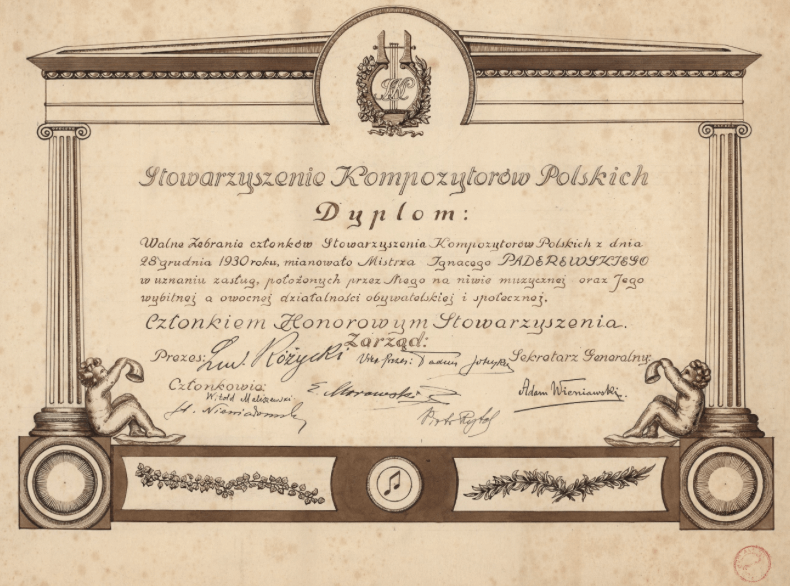
In 2025, the Polish musical world celebrated a moment of exceptional importance: the 100th anniversary of the organized association of Polish composers. What began in 1925 with the founding of the pre-war Association of Polish Composers continues today through the Polish Composers’ Union (Związek Kompozytorów Polskich, ZKP). For me, as a composer and a member of this Society, the centenary is not only a historical milestone—it is a deeply personal moment of reflection on continuity, responsibility, and artistic identity.
The origins of ZKP reach back to the cultural energy of the interwar period, when figures such as Karol Szymanowski, Ludomir Różycki, and Grzegorz Fitelberg understood that Polish music needed not only individual voices, but also a collective structure—one that would protect creative independence and strengthen Poland’s presence on the international musical stage. The early members of the Society—Tadeusz Joteyko, Ludomir Michał Rogowski, Stanisław Niewiadomski, Adam Wieniawski, Piotr Rytel, and others—laid foundations that continue to shape our thinking about the role of the composer in society.
The rebirth of the Union in 1945, in the aftermath of war and destruction, stands as one of the most powerful symbols of resilience in Polish cultural history. Names such as Piotr Perkowski, Roman Palester, Stanisław Wiechowicz, Witold Lutosławski, Jan Ekier, and Bolesław Woytowicz remind us that ZKP was rebuilt not merely as an administrative institution, but as a moral and artistic shelter. In times of political pressure and ideological control, the Union often functioned as a space where artistic integrity could survive—even quietly, even imperfectly.

1st General Reunion of The Polish Composers’ Union (Związek Kompozytorów Polskich, ZKP) in Cracow, August 29 - Sept. 1, 1945 (among the present Grażyna Bacewicz, Stefan Kisielewski, Andrzej Dobrowolski).
As a composer working today, I feel a strong sense of gratitude for this legacy. The fact that ZKP brought together composers and musicologists, creation and reflection, practice and scholarship, has had a lasting impact on the depth and seriousness of Polish musical culture. One cannot speak about ZKP without acknowledging the founding of the Warsaw Autumn Festival (“Warszawska Jesień”) in 1956—an event that courageously opened Polish music to the most radical artistic currents of its time and continues to be one of Europe’s most important platforms for contemporary music.
Festival was one of the most important events in Poland and brought a lot of guests from abroad to Poland. It became a vital bridge between East and West during the Cold War, premiering works by major composers. Warsaw Autumn introduced audiences to major 20th and 21st century composers such as Boulez, Stockhausen, Messiaen, Cage, Ligeti, Lutosławski, Penderecki, Xenakis, and Berio, while also promoting new voices. It played a crucial role in the development of the Polish contemporary music. The festival is still held annually in September and features orchestral concerts, chamber music, electronics, sound installations, interdisciplinary projects, and discussions. Its curatorial approach emphasizes aesthetic diversity, experimentation, and critical reflection.

After the performance of Grażyna Bacewicz’s VI String Quartet during the IV International Festival of Contemporary Music “Warsaw Autumn” (“Warszawska Jesień”), September 1960. From the left: Tadeusz Ochlewski, Krzystof Penderecki, Andre Spisakova, Michał Spisak, Grażyna Bacewicz, Alina Bacewicz, NN.
Krzysztof Penderecki and LaSalle Quartet with the score of Quartetto per archi which received its first performance during the VI “Warsaw Autumn,” September 1962.
Gathering at the closing of the VIII “Warsaw Autumn,” September 1963: John Cage, Stefan Śledziński and Bolesław Szabelski. Photos by Andrzej Zborski.
The centenary celebrations —centered in Warsaw, with concerts, conferences, and archival exhibitions— reminded us that ZKP was not a closed chapter of history but a living organism. The inclusion of the 68th Warsaw Autumn Festival in the jubilee program, the Centenary Festival “100 Years of ZKP,” and the gala concert at the Warsaw Philharmonic all reflected the remarkable stylistic and generational diversity of Polish music today.
For me personally, being a member of ZKP but living in the USA means entering into a dialogue across time and staying connected with Polish musical thought—against a century-long tradition of artistic courage, ethical responsibility, and intellectual independence. Membership is not merely an honor; it is an obligation to contribute honestly, critically, and creatively to a shared cultural space. In New York City in 2025 the New York Dance and Arts Innovations and 27th International Chopin and Friends Festival paid tribute to the anniversary on November 4 at the Polish Consulate in NYC for what I would like to thank the current Directors: Radosia Jasik and Andrea Domenici.
As the Union looks toward its second century, I am especially encouraged by the presence of young composers, the activities of the Youth Circle, and the emphasis on new works and premieres. These initiatives affirm that the future of Polish music will not be built on nostalgia, but on curiosity, openness, and the freedom to question inherited forms. The 100th anniversary of ZKP is therefore not only a celebration of the past. It is a reaffirmation of a living idea: that music matters, that composers need community, and that artistic freedom—once earned—must be continuously protected and renewed. The Union stands proud within this tradition and carries it forward into the next generations.
Wishing the newly elected Board and its president Beata Bolesławska-Lewandowska Happy 2026 and many new projects for the society and composers.

42nd General Reunion of ZKP, in front of Chopin’s Museum in Warsaw, June 2025. Phot. Maciej Borowski
Official website of the Polish Composers’ Union (ZKP): www.zkp.org.pl
Centenary anniversary website with historical documents and photos, including special guests such as Nadia Boulanger, Dmitri Shostakovich, Benjamin Britten, Louis Andriessen, Olivier Messiaen: https://100latzkp.org.pl/
Program of the anniversary festival: https://100latzkp.org.pl/pdfy/100ksiazka_programowa.pdf
XXVII International Chopin & Friends Festival: https://www.nydai.org/international-chopin-@9friends-festival-2025/

Jakub Polaczyk is a composer and pianist based in New York City. His works have been performed internationally at major venues, including Carnegie Hall and the Musikverein in Vienna. He is a recipient of the Golden Cross of Merit of the President of Poland, the Gloria Artis Medal for Merit to Culture, and numerous international composition awards.


Comments